
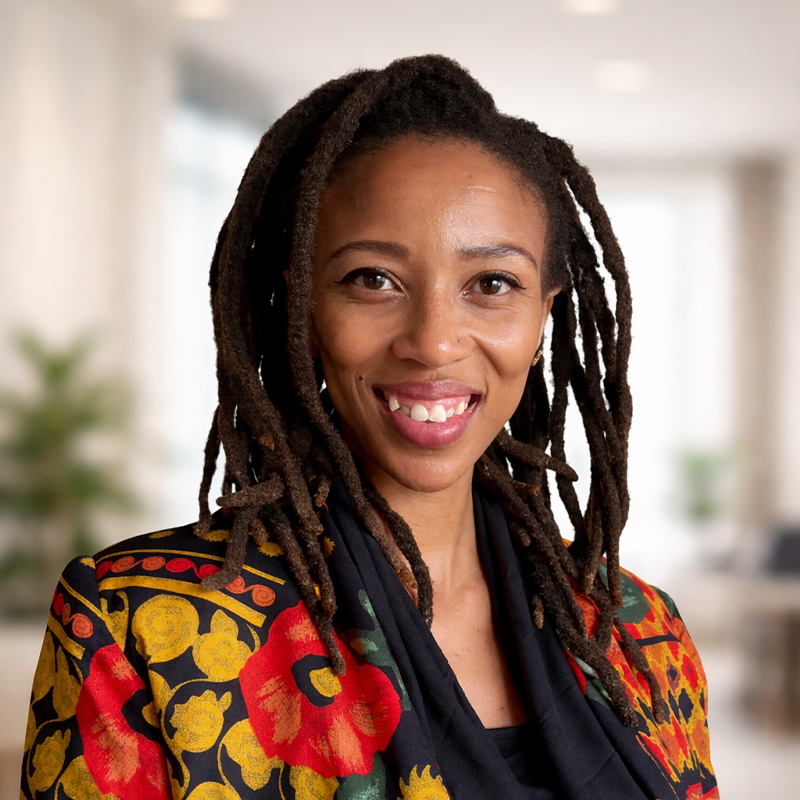
Palesa Nqambaza is an essayist and researcher whose work sits at the intersections of gender and race studies within the context of South African political history. Her work draws from indigenous epistemologies and various Black cultural forms to explore the intellectual and political dimensions of contemporary South Africa. Her current core project is an intellectual archaeology of South African feminist traditions. She is a CDTA Postdoctoral fellow at the University of the Witwatersrand, South Africa, and a recipient of the ARUA Early Career Fellowship, based at the Notions of Identity CoE.
Seminar Topic: Rethinking Amadikazi: Kinship, Autonomy, and the Politics of Naming
Abstract
In contemporary South Africa, the idea of amadikazi is steeped in discourses of promiscuity, concubinage, and moral depravity. However, these discourses simplify and flatten the designation idikazi (the singular of Amadikazi), which the earliest written records document as a complex and subversive subjectivity ordinarily defined as a kinship position occupied by an unmarried mother who raises her children within her natal kin group. A this intellectual archaeology of the idea of amadikazi suggests that the idea of ubudikazi is historically layered and contested. It is a concept that has shifted in response to the moral, religious, economic, and political dictates of a society that has undergone significant transformations from indigenous social formations to colonised, proletarianised, Christianised, and peri-urbanised contexts.
While not a celebrated kinship category, the position of Amadikazi signals one of the earliest subversive subjectivities to patriarchal domination, and it ought to inform foundational thinking about what an indigenous African feminist intellectual history might look like in the South African context. The subjectivity of ubudikazi offers insight into what gender scholarship often overlooks when it treats “women” as a homogenous category. This paper will demonstrate why taking seriously the complex workings of indigenous kinship groups reveals how status and/or (dis)privilege is distributed within indigenous sex/gender systems. In this way, a decolonial alternative to thinking about feminist intellectual histories in South Africa is presented.